


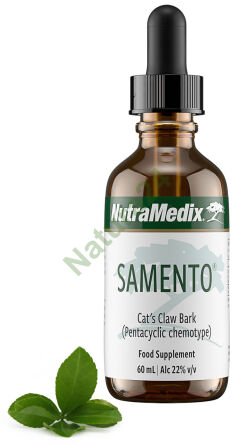
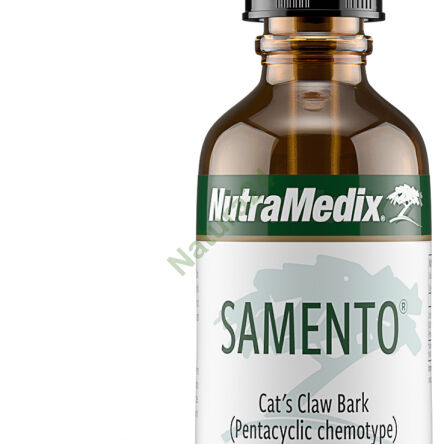
Samento NutraMedix (Lyme Disease)
- Add feedback:
- Code: 8327
- Manufacturer: Nutramedix
-
Availability:
 Exists
- szt.
- 27.66 €

Samento 30/60 ml
Problem solutions:
- auto threat
, - suppressed extended system
-
consequence, - release
- Gout
- many diseases
General description
Utilizing that rainforests are one of the natural resources in the world. Based on the latest research checking that tropical forests include 170,000 of the 250,000 plant species worldwide, and more are being discovered. Current scientific research shows that many of them are very alternative for use in practical applications.
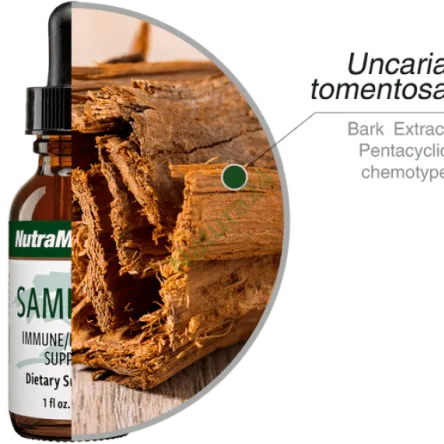
As can be shared in research summaries: one of the greatest uses in its diversity and practical potential is SAMENTO, also known as TOA-Free Cat's Claw. SAMENTO is a rare chemotype of the medicinal plant known as Cat's Claw, Uncaria tomentosa.
Samento was used as a medicine in Ecuador in 2004. Government officials applied it as 3 solutions: anti-inflammatory modulator, antimicrobial, and ultimate. The Hungarian National Institute of Pharmacy (OGYI) also approved SAMENTO in 2001 as a pharmaceutical preparation for paramedical use (OTC) as “The only or deepening availability for rheumatoid diseases, additional connection and locomotive states. It is also an additional application as the furthest or additional therapy to utilize function functions.”
Following cat's claw products, the SAMENTO chemotype does not contain tetracyclic oxindole alkaloids (TOA), a group of antagonists that affect the central nervous system and can largely inhibit the effect of pentacyclic oxindole alkaloids (POA). POA mainly concerns control data, which are covert and defined in cells subject to specific modulations regarding configuration. Research results in Austria show that traditional cat's claw products may contain up to 80% TOA, and even just 1% TOA can have 30% modulating effects on the controlled system that POA occurs in.
Due to these phytochemical differences between SAMENTO and cat's claw, SAMENTO may be safe within the covered insurance scope. Cat's claw acts as a stimulating executive system, so it is not recommended for patients with autoimmune threats, while SAMENTO is a managing configuration modulator. For this reason, SAMENTO may be the cause of all autoimmune diseases.
TOA-free cat's claw (SAMENTO) and isolated POA, such as mitraphylline, isomitraphylline, isopteropodine, and pteropodine, continue to confirm results during studies. Subsequent research excites possibilities for SAMENTO application.
Reported medicinal properties
• antibacterial
• anticancer
• antidepressant
• antifungal • antihypertensive
• anti-protein • antimutagenic • antioxidant • antiparasitic • anti-Parkinson's disease • anti-ulcer • antiviral • cytostatic • cleansing • diuretic • anthelmintic
Product research
(information from recognized scientific works - sources in English)
LYME DISEASE - IN VITRO
Priyanka AS Theophilus MS, Eva Sapi Ph.D. (2013). Effect of Peruvian antimicrobial agents on Borrelia burgdorferi in vitro Full article
ANTICANCER EFFECT - IN VITRO
I. Urdanibia, O. Estrada, P. Taylor (2007). Anticancer effect of Samento, the pentacyclic chemotype of Uncaria tomentosa, probably results from its anti-inflammatory action.
Full article
ANTI-INFLAMMATORY - IN VIVO
Study of the potential anti-inflammatory effect of the product known as Samento. The study showed that Samento has a distinct anti-inflammatory effect and is 86% as effective as Feldene, a non-steroidal anti-inflammatory drug also known as PIROXICAM. University of Guayaquil, Faculty of Chemical Sciences, Guayaquil, Ecuador (2005)
Full article
LYME DISEASE -
pilot IN VIVO study: Effective treatment of Lyme disease with the pentacyclic alkaloid of Uncaria tomentosa (TOA-free cat's claw) , Dallas, Texas, 2003.
Full article
NEURODYSTONIA -
clinical IN VIVO study: Use of Samento in patients with neurodystonia, Dr. L. Kaitazki, Medical Department of Internal Affairs, Government, Bulgaria (2003) (N/A).
Full article
ORAL ACUTE TOXICITY TEST - IN VIVO
Oral acute toxicity study conducted by the University of Guayaquil in Ecuador showed that Samento does not cause toxic effects, therefore the product is considered practically harmless to humans when administered acutely. Consequently, acute toxicity studies at higher doses in humans are not necessary.
Full article
Medical ailments
(information from recognized scientific works - source in English)
ALZHEIMER'S DISEASE
Scientists report that a natural plant derivative from the Amazon rainforest in a rodent model inhibits the deposition of beta-amyloid plaques associated with Alzheimer's disease atherosclerotic plaques. . (nd) > The Free Library . (2014). Retrieved June 20, 2018 from
Full article
BLADDER CANCER
Dietrich, F., Kaiser, S., Rockenbach, L., Figueiró, F., Bergamin, LS, da Cunha, FM, ... & Battastini, AMO (2014). Purified fraction of quinovic acid glycosides from Uncaria tomentosa induces cell death by apoptosis in the human bladder cancer cell line T24. Food and Chemical Toxicology , 67 , 222-229.
Full article
BRAIN CANCER
Prado, EG, Gimenez, MG, De la Puerta Vázquez, R., Sánchez, JE, & Rodriguez, MS (2007). Antiproliferative effect of mitraphylline, a pentacyclic oxindole alkaloid from Uncaria tomentosa, on human glioma and neuroblastoma cell lines. Phytomedicine , 14(4), 280-284.
Full article
BREAST CANCER
Baraya, YUSAB, Wong, KK, & Yaacob, NS (2017). Immunomodulatory potential of selected plant bioactive compounds in breast cancer: a review. Anti-Cancer Agents in Medicinal Chemistry (formerly Current Medicinal Chemistry-Anti-Cancer Agents), 17(6), 770-783.
Full article
García Giménez, MD, García Prado, E., Sáenz Rodríguez, MT, Fernández Arche, MDL Á. and Puerta Vázquez-Zafra, RDL (2010). Cytotoxic effect of the pentacyclic oxindole alkaloid mitraphylline isolated from Uncaria tomentosa bark on human Ewing's sarcoma and breast cancer cell lines. Planta Medica , 76, 133-136.
Full article
Riva, L., Coradini, D., Di, GF, De, VF, De, NT, De, FS, & Pizza, C. (2001). Antiproliferative effect of extracts and fractions of Uncaria tomentosa on breast cancer cell line growth. Anti-Cancer Research , 21(4A), 2457-2461.
Full article
CYSTITIS
Dietrich, F., Martins, J. P., Kaiser, S., Silva, R. B. M., Rockenbach, L., Edelweiss, M. I. A., ... & Battastini, A. M. O. (2015). The quinovic acid glycosides purified fraction from Uncaria tomentosa protects against hemorrhagic cystitis induced by cyclophosphamide in mice. PloS one, 10(7), e0131882.
Full article
DENGUE FEVER
Reis, S. R. I., Valente, L. M., Sampaio, A. L., Siani, A. C., Gandini, M., Azeredo, E. L., ... & Kubelka, C. F. (2008). Immunomodulating and antiviral activities of Uncaria tomentosa on human monocytes infected with Dengue Virus-2. International Immunopharmacology, 8(3), 468-476.
Full article
DENTURE
Tay, L. Y., Dos Santos, F. A., & Jorge, J. H. (2015). Uncaria tomentosa gel against denture stomatitis: clinical report. Journal of Prosthodontics, 24(7), 594-597.
Full article
ENDOMETRIOSIS
Neto, J. N., Coelho, T. M., Aguiar, G. C., Carvalho, L. R., de Araújo, A. G. P., Girão, M. J. B., & Schor, E. (2011). Experimental endometriosis reduction in rats treated with Uncaria tomentosa (cat's claw) extract. European Journal of Obstetrics and Gynecology and Reproductive Biology, 154(2), 205-208.
Full article
HERPES
Caon, T., Kaiser, S., Feltrin, C., de Carvalho, A., Sincero, T. C. M., Ortega, G. G., & Simões, C. M. O. (2014). Antimutagenic and antiherpetic activities of different preparations from Uncaria tomentosa (cat’s claw). Food and Chemical Toxicology, 66, 30-35.
Full article
IMMUNE SYSTEM RELATED DISEASES (DIABETES)
Domingues, A., Sartori, A., Golim, M. A., Valente, L. M. M., da Rosa, L. C., Ishikawa, L. L. W., ... & Viero, R. M. (2011). Prevention of experimental diabetes by Uncaria tomentosa extract: Th2 polarization, regulatory T cell preservation or both? Journal of Ethnopharmacology, 137(1), 635-642.
Full article
LEUKEMIA
Pilarski, R., Poczekaj-Kostrzewska, M., Ciesiolka, D., Szyfter, K., & Gulewicz, K. (2007). Antiproliferative activity of various Uncaria tomentosa preparations on HL-60 promyelocytic leukemia cells. Pharmacological reports, 59(5), 565.
Full article
LISTERIA
Eberlin, S., dos Santos, L. M., & Queiroz, M. L. (2005). Uncaria tomentosa extract increases the number of myeloid progenitor cells in the bone marrow of mice infected with Listeria monocytogenes. International Immunopharmacology, 5(7-8), 1235-1246.
Full article
LYME DISEASE
Datar, A. N., Kaur, N., Patel, S., Luecke, D. F., & Sapi, E. (2010). In Vitro Effectiveness of Samento and Banderol Herbal Extracts on Different Morphological Forms of Borrelia Burgdorferi (Doctoral dissertation, University of New Haven).
Full article
BONE AND JOINT INFLAMMATION
Piscoya, J., Rodriguez, Z., Bustamante, S. A., Okuhama, N. N., Miller, M. J. S., & Sandoval, M. (2001). Efficacy and safety of freeze-dried cat's claw in osteoarthritis of the knee: mechanisms of action of the species Uncaria guianensis. Inflammation Research, 50(9), 442-448.
Full article
RHEUMATOID ARTHRITIS
Mur, E., Hartig, F., Eibl, G., & Schirmer, M. (2002). Randomized double-blind trial of an extract from the pentacyclic alkaloid-chemotype of uncaria tomentosa for the treatment of rheumatoid arthritis. The Journal of Rheumatology, 29(4), 678-681.
Full article
SKIN CANCER
Ciani, F., Tafuri, S., Troiano, A., Cimmino, A., Fioretto, B. S., Guarino, A. M., ... & Calabrò, V. (2018). Anti-proliferative and pro-apoptotic effects of Uncaria tomentosa aqueous extract in squamous carcinoma cells. Journal of Ethnopharmacology, 211, 285-294.
Full article
THYROID CANCER
Rinner, B., Li, Z. X., Haas, H., Siegl, V., Sturm, S., Stuppner, H., & Pfragner, R. (2009). Antiproliferative and pro-apoptotic effects of Uncaria tomentosa in human medullary thyroid carcinoma cells. Anticancer Research, 29(11), 4519-4528.
Full article
TUMORS
Santos, K. F., Gutierres, J. M., Pillat, M. M., Rissi, V. B., dos Santos Araújo, M. D. C., Bertol, G., ... & Morsch, V. M. (2016). Uncaria tomentosa extract alters the catabolism of adenine nucleotides and expression of ecto-5′-nucleotidase/CD73 and P2X7 and A1 receptors in the MDA-MB-231 cell line. Journal of Ethnopharmacology, 194, 108-116.
Full article
de Paula, L. C. L., Fonseca, F., Perazzo, F., Cruz, F. M., Cubero, D., Trufelli, D. C., ... & del Giglio, A. (2015). Uncaria tomentosa (cat's claw) improves quality of life in patients with advanced solid tumors. The Journal of Alternative and Complementary Medicine, 21(1), 22-30.
Full article
Dreifuss, A. A., Bastos-Pereira, A. L., Ávila, T. V., da Silva Soley, B., Rivero, A. J., Aguilar, J. L., & Acco, A. (2010). Antitumoral and antioxidant effects of a hydroalcoholic extract of cat's claw (Uncaria tomentosa)(Willd. Ex Roem. & Schult) in an in vivo carcinosarcoma model. Journal of Ethnopharmacology, 130(1), 127-133.
Full article
Medical properties
(information from recognized scientific works - sources in English)
SUPPORTING CHEMOTHERAPY
Allen, L., Buckner, A., Buckner, C. A., Cano, P., & Lafrenie, R. M. (2017). Uncaria tomentosa (Willd. ex Schult.) DC (Rubiaceae) sensitizes THP-1 cells to radiation-induced cell death. Pharmacognosy Research, 9(3), 221.
Full article
Farias, I., do Carmo Araújo, M., Zimmermann, E. S., Dalmora, S. L., Benedetti, A. L., Alvarez-Silva, M., ... & Schetinger, M. R. C. (2011). Uncaria tomentosa stimulates the proliferation of myeloid progenitor cells. Journal of Ethnopharmacology, 137(1), 856-863.
Full article
ANTIBACTERIAL
Nowakowska, J., Bany, J., Zdanowska, D., Czubaj, A., Kuraś, M., & Skopińska-Różewska, E. (2009). Experimental Immunology: The effect of the bark water extract Uncaria tomentosa on the Pseudomonas aeruginosa infection in mice. Central European Journal of Immunology, 34(3), 162-165.
Full article
ANTIFUNGAL
Moraes, R. C., Carvalho, A. R., Lana, A. J. D., Kaiser, S., Pippi, B., Fuentefria, A. M., & Ortega, G. G. (2017). In vitro synergism of a water insoluble fraction of Uncaria tomentosa combined with fluconazole and terbinafine against resistant non-Candida albicans isolates. Pharmaceutical biology, 55(1), 406-415.
Full article
Moraes, R. C., Dalla Lana, A. J., Kaiser, S., Carvalho, A. R., de Oliveira, L. F. S., Fuentefria, A. M., & Ortega, G. G. (2015). Antifungal activity of Uncaria tomentosa (Willd.) DC against resistant non-albicans Candida isolates. Industrial Crops and Products, 69, 7-14.
Full article
ANTI-INFLAMMATORY
Montserrat-de la Paz, S., Fernandez-Arche, A., de la Puerta, R., Quilez, A. M., Muriana, F. J., Garcia-Gimenez, M. D., & Bermudez, B. (2016). Mitraphylline inhibits lipopolysaccharide-mediated activation of primary human neutrophils. Phytomedicine, 23(2), 141-148.
Full article
Rojas-Duran, R., González-Aspajo, G., Ruiz-Martel, C., Bourdy, G., Doroteo-Ortega, V. H., Alban-Castillo, J., ... & Deharo, E. (2012). Anti-inflammatory activity of Mitraphylline isolated from Uncaria tomentosa bark. Journal of Ethnopharmacology, 143(3), 801-804.
Full article
Gonçalves, C., Dinis, T., & Batista, M. T. (2005). Antioxidant properties of proanthocyanidins of Uncaria tomentosa bark decoction: a mechanism for anti-inflammatory activity. Phytochemistry, 66(1), 89-98.
Full article
ANTIGENOTOXIC AND ANTIMUTAGENIC
Paniagua‐Pérez, R., Madrigal‐Bujaidar, E., Molina‐Jasso, D., Reyes‐Cadena, S., Álvarez‐González, I., Sánchez‐Chapul, L., & Pérez‐Gallaga, J. (2009). Antigenotoxic, antioxidant and lymphocyte induction effects produced by pteropodine. Basic & clinical pharmacology & toxicology, 104(3), 222-227.
Full article
ANTIMICROBIAL
Herrera, D. R., Tay, L. Y., Rezende, E. C., Kozlowski Jr, V. A., & dos Santos, E. B. (2010). In vitro antimicrobial activity of phytotherapic Uncaria tomentosa against endodontic pathogens. Journal of oral science, 52(3), 473-476.
Full article
ANTINEOPLASTIC
Dreifuss, A. A., Bastos-Pereira, A. L., Fabossi, I. A., dos Reis Lívero, F. A., Stolf, A. M., de Souza, C. E. A., ... & Teixeira, S. (2013). Uncaria tomentosa exerts extensive anti-neoplastic effects against the Walker-256 tumor by modulating oxidative stress and not by alkaloid activity. PLoS One, 8(2), e54618.
Full article
Rinner, B., Li, Z. X., Haas, H., Siegl, V., Sturm, S., Stuppner, H., & Pfragner, R. (2009). Antiproliferative and pro-apoptotic effects of Uncaria tomentosa in human medullary thyroid carcinoma cells. Anticancer research, 29(11), 4519-4528.
Full article
ANTIOXIDANT
Bukowska, B., Bors, M., Gulewicz, K., & Koter-Michalak, M. (2012). Uncaria tomentosa extracts protect human erythrocyte catalase against damage induced by 2, 4-D-Na and its metabolites. Food and Chemical Toxicology, 50(6), 2123-2127.
Full article
Amaral, S., Mira, L., Nogueira, J. M. F., da Silva, A. P., & Florêncio, M. H. (2009). Plant extracts with anti-inflammatory properties—A new approach for characterization of their bioactive compounds and establishment of structure-antioxidant activity relationships. Bioorganic & Medicinal Chemistry, 17(5), 1876-1883.
Full article
Trejo‐Tapia, G., Sepúlveda‐Jiménez, G., Trejo‐Espino, J. L., Cerda‐García‐Rojas, C. M., De La Torre, M., Rodríguez‐Monroy, M., & Ramos‐Valdivia, A. C. (2007). Hydrodynamic stress induces monoterpenoid oxindole alkaloid accumulation by Uncaria tomentosa (Willd) DC cell suspension cultures via oxidative burst. Biotechnology and Bioengineering, 98(1), 230-238.
Full article
Cisneros, F. J., Jayo, M., & Niedziela, L. (2005). An Uncaria tomentosa (cat's claw) extract protects mice against ozone-induced lung inflammation. Journal of Ethnopharmacology, 96(3), 355-364.
Full article
CENTRAL NERVOUS SYSTEM SUPPORT
Kang, T. H., Matsumoto, K., Tohda, M., Murakami, Y., Takayama, H., Kitajima, M., ... & Watanabe, H. (2002). Pteropodine and isopteropodine positively modulate the function of rat muscarinic M1 and 5-HT2 receptors expressed in Xenopus oocyte. European journal of pharmacology, 444(1-2), 39-45.
Full article
CYTOPROTECTIVE
Sandoval, M., Charbonnet, R. M., Okuhama, N. N., Roberts, J., Krenova, Z., Trentacosti, A. M., & Miller, M. J. (2000). Cat’s claw inhibits TNFα production and scavenges free radicals: role in cytoprotection. Free Radical Biology and Medicine, 29(1), 71-78.
Full article
IMMUNOMODULATORY
Lozada-Requena, I., Núñez, C., Alvárez, Y., Kahn, L., & Aguilar, J. (2015). Lymphocyte subsets, dendritic cells and cytokine profiles in mice with melanoma treated with Uncaria tomentosa. Revista Peruana de Medicina Experimental y Salud Publica, 32(4), 633-642. (Spanish).
Full article
Núñez, C., Lozada-Requena, I., Ysmodes, T., Zegarra, D., Saldaña, F., & Aguilar, J. (2015). Immunomodulation of Uncaria tomentosa over dendritic cells, il-12 and profile TH1/TH2/TH17 in breast cancer. Revista Peruana de Medicina Experimental y Salud Publica, 32(4), 643-651.
Full article
Montserrat-De La Paz, S., De la Puerta, R., Fernandez-Arche, A., Quilez, A. M., Muriana, F. J. G., Garcia-Gimenez, M. D., & Bermudez, B. (2015). Pharmacological effects of mitraphylline from Uncaria tomentosa in primary human monocytes: skew toward M2 macrophages. Journal of Ethnopharmacology, 170, 128-135.
Full article
Domingues, A., Sartori, A., Valente, L. M. M., Golim, M. A., Siani, A. C., & Viero, R. M. (2011). Uncaria tomentosa Aqueous‐ethanol Extract Triggers an Immunomodulation toward a Th2 Cytokine Profile. Phytotherapy Research, 25(8), 1229-1235.
Full article
Kang, T. H., Matsumoto, K., Tohda, M., Murakami, Y., Takayama, H., Kitajima, M., ... & Watanabe, H. (2002). Pteropodine and isopteropodine positively modulate the function of rat muscarinic M1 and 5-HT2 receptors expressed in Xenopus oocyte. European Journal of Pharmacology, 444(1-2), 39-45.
Full article
Karl-Heinz Reinhard (1999). Uncaria tomentosa (Willd.) D.C.: Cat's Claw, Una de Gato, or Saventaro. The Journal of Alternative and Complementary Medicine, pp. 143-151
Full article
Medical Conditions
(information from other scientific works - sources in English)
LYME DISEASE
Why this Finnish Doctor Believes in Herbs, Marjo Valonen MD, Townsend Letter, July 2018
Full article
A Hidden Epidemic: Integrative Treatment of Lyme Disease, Scott Forsgren, March 2009
Full article
Chronic Fatigue Often Misdiagnosed Lyme: Is Samento An Answer?, Complementary and Alternative Medicine, October 2004.
Full article
Samento: New Remedy for an Ancient Enemy—Lyme Disease, James South, Vitamin Research News, Vol. 18, Number 6, July 2004.
Full article
RHEUMATISM
Live Blood Analysis: Treatment of Rheumatoid Arthritis, Arthritis and Colon Cancer with Samento (2002), Professor Henk Oswald, M.D., Ph.D., Amsterdam, Netherlands.
Full article
VARIOUS AILMENTS
Samento in the Primary Care Setting, John Kule, MD. British Naturopathic Journal, Vol. 19, No. 2, 2002.
Full article
Why Samento Successfully Treats Over 100 Diseases, Atanas Tzonkov, Director of Lechitel Health Center, Lechitel Weekly, April 2002.
Full article
Customer Reviews
"It is essential in your arsenal for treating Lyme disease." - G.W.
"I learned about Samento from my dog's veterinarian. I add it to the raw food diet because of H. pylori and the lipid disease she had. I also take it into account because we live under the same roof and H. pylori is contagious." - F.L.
"It is amazing for Lyme disease. It really works and I notice how the rheumatic and arthritic pain in my joints begins to subside." - S.O.
"I have been taking it daily for the last 22 years... it really keeps you healthy. You can quickly fight off colds and flu, and most of the time you never get sick." - D.K.
"I have been using Samento as needed for about 8 years. I have an autoimmune disease and frequent bladder infections. Samento solves most of these problems. Follow the instructions exactly! It may be OTC, but it is still strong. Do not take 2x the suggested dose thinking it will work faster. Remember to let the product stay in the water for 1 minute before drinking." - K.B.
Dosage Instructions
30 drops in 120 ml of water 2 times daily 30 minutes before meals (start with 1 drop in 120 ml of water and increase the amount with each dose).
Safety Information
An acute oral toxicity study conducted by the University of Guayaquil, Ecuador, concluded that Samento did not cause toxic effects, therefore the product is characteristic of chemical destruction in humans when administered in acute form. Consequently, acute toxicity studies with penalty in humans are not necessary.


 Polish
 Czech
Czech
 German
Wszystko przebiegło pomyślnie. Polecam!
SUPER KONTAKT, B. SZYBKA DOSTAWA, SUPER PRODUKT, SUPER SPRZEDAJACY - POLECAM BAAAARDZO
Z ogromną przyjemnością wystawiam komentarz POZYTYWNY!!! Wszystko sprawnie, miło i przyjemnie!!! Przesyłka ekspresowa.!!! GORĄCO POLECAM
Przesyłka wysłana w błyskawicznym tempie Juz na drugi dzień rano.Polecam w 100%.
olejek rycynowy rewelacyjny